Preservation is the engine of innovation
We treat preserving and inventing as opposites. Cooks knew better: a sourdough starter is a fork with its lineage attached.
Before I ever attempted the Father's Office Burger, I spent a couple of weeks learning to caramelise onions the Indian way. Butter, very low heat, no sugar, no water, no shortcuts — just patience and a lot of hand-stirring so nothing catches.
By the time I made the burger, those were the only onions I knew how to make. They've been the onions ever since. They come out sweeter than the standard version, sweet enough that the rest of the recipe had to change around them.
I didn't invent anything. I carried a technique from one tradition into a dish from another, and the collision produced something that was mine.
That's the whole argument, and I want to make the case for it properly.
We tend to think of preservation and innovation as opposites. Museums preserve. Kitchens innovate. One protects the past, the other breaks from it.
The tradeoff feels obvious. It's also wrong, and the reason it feels true isn't philosophical. It's structural. It's about how we store what we know.
Cooks invented version control. We called it a starter
Long before anyone wrote a line of code, bakers had solved a problem software wouldn't get to for another few thousand years.
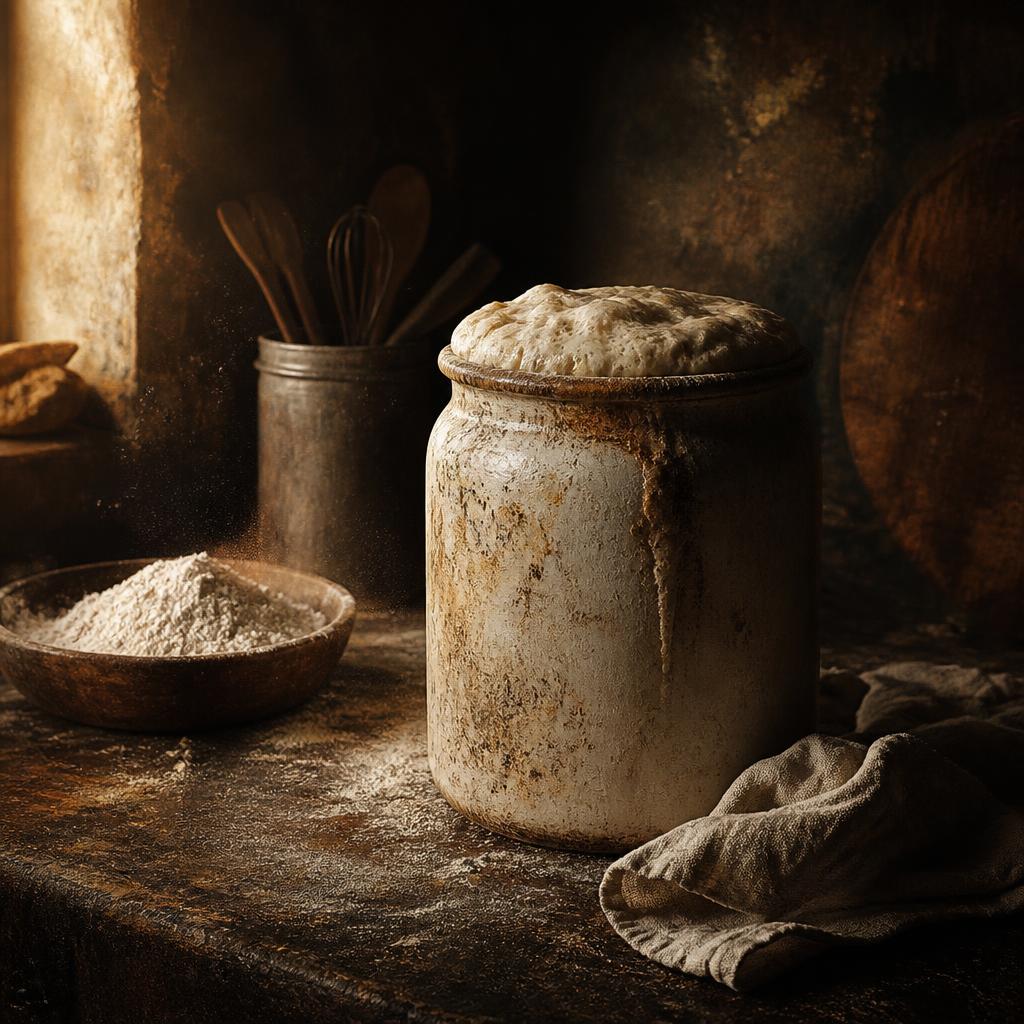
A sourdough starter is a living thing you split and hand to someone else. It carries where it's been — the flours it was raised on, the water, the kitchen, the person who kept it alive through a bad winter. The baker who receives it makes bread that has never existed before, out of something continuous with everything that came before.
That is a fork with its lineage attached.
Sherry does the same thing with solera: you never empty the barrel, so the oldest wine is perpetually present in trace amounts in every bottle. Vinegar has its mother. Kefir has its grains. Seed banks exist so that breeders have something to breed from — the Crop Trust vault isn't a museum, it's a supply of raw material for agriculture that doesn't exist yet.
None of these preserve by freezing. They preserve by staying in use, and the preservation is exactly what makes the next thing possible. Take the starter away and you don't get more innovation. You get worse bread.
What we did to the recipe
On the internet, a recipe is a document. A title, a list of ingredients, a set of steps. Static, and detached from everything that produced it.
That's not what a recipe is. A recipe is a set of decisions somebody made — substitutions forced by what the market had, adjustments for an oven that runs hot, a technique someone was taught by someone else. The document keeps the outcome and throws away the reasoning.
We flatten it and lose more than history. We lose the memory, and without memory the next version has nothing to stand on.
Think about how a new dish gets made now. A chef experiments, combines influences, adjusts, iterates. But nothing in the system around them can trace where an idea came from, show what changed, or record why. So every creation sits in isolation. Every fusion forgets what it fused. Every variation is a dead end that has to be rediscovered from scratch by the next person.
We call that innovation. A lot of it is just churn.
Access, not rupture
Real innovation doesn't come from breaking with the past. It comes from being able to see it — what existed, what changed, what worked, what didn't, and why somebody bothered.
The richer the memory, the more meaningful the variation. This is why cooking traditions with deep, well-transmitted technique produce more interesting new food than traditions that have been reduced to a list of dishes. The technique is the compounding asset. The dish is just the current balance.
Software eventually worked this out. You don't overwrite code, you fork it, and every change knows where it came from. Innovation compounds because memory is built into the system rather than bolted on afterwards.
Food had this first, in the starter jar. Then we wrote it down as documents and lost it.
What it looks like to have it back
I've been building Amanah as an attempt to put it back.
Underneath it, recipes aren't documents. They're structured objects that carry their own origin, so a recipe can be forked into a new version without the connection being severed. Not copied. Extended. You can follow a dish backwards to see where it came from, or forwards to see what people made of it.
My salsa verde has three descendants on the platform now — a burger dressing, a steak burger, and a plate of braised short rib tacos. None of those is a copy. Each is somebody deciding this thing is good and it could also be this. The link between them isn't a footnote. It's part of the record.
And there are forty-eight recipes on there under the name of a woman who died a few years ago. My grandmother, Isabel Güemez Ruyan — Titi. She raised twelve children in Mexico City, cured her own jamón serrano, and cooked the whole world out of one kitchen decades before that was easy. She never had an account and she never will. I hold her profile as her custodian, which is a real role in the software and not a sentiment.
That's preservation. It's also the most generative thing on the platform, because now her recipes can be built on by people who never met her, and the building will still say where it started.
Not everything survives, and that's the point
Open forking without any weight would just be noise. Some variations are experiments, some are refinements, most are dead ends.
So recipes aren't only stored, they're used — cooked, adapted, repeated. A dish that many people have actually made and trusted carries a different kind of authority than one that was merely published, and not because anyone declared it better. Because there's evidence.
Meanwhile every variation stays accountable to what it came from. You can always see what changed and how far it has drifted. Innovation doesn't erase the past; it stays attached to it, which is the only reason the drift means anything.
It's early. There's a lot that isn't built and more that isn't proven. But the shape is there, and you can see it at amanah.food.
If any of this lands, follow along. And if you have a grandmother's recipes in a drawer somewhere — that's not an archive. That's a starter.